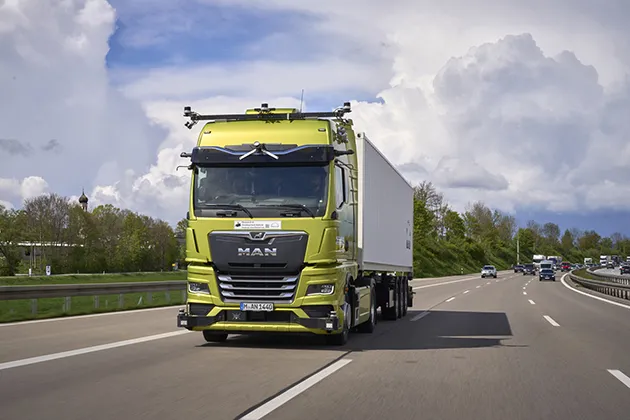
MAN reached a significant milestone by deploying an autonomous truck on a German motorway, marking the first instance of a commercial vehicle manufacturer doing so.
MAN Makes History: First Commercial Vehicle Manufacturer with Level 4 Motorway Test Permit
The test truck, traversing about 10 kilometres on the A9 between the Allershausen and Fürholzen junctions, hosted Federal Transport Minister Dr Volker Wissing and MAN CEO Alexander Vlaskamp on board.
MAN says it has been actively advancing the development of autonomous trucks for logistics hubs and hub-to-hub traffic on motorways. Recently, it became the first commercial vehicle manufacturer to obtain a Level 4 test permit under German motorway autonomous driving laws.
With freight volumes, especially between logistics hubs like the warehouses of large online department stores that are steadily increasing, autonomous trucks are seen as well-suited for this hub-to-hub transport. They are always on the road, highly fuel-efficient and safe to drive. Eliminating driving time breaks allows seamless integration into synchronised logistics processes. In the long term, autonomous trucks could reduce overall operating costs by 10 to 15 per cent and alleviate truck driver shortage, which currently stands at up to 100,000 drivers in Germany alone.
“Today we are taking another big step towards autonomous commercial vehicles, the second major future field alongside the switch to CO2-free drives. This year, we are initially running tests with prototypes on the motorway. Further hub-to-hub projects would follow from 2025 but then in typical customer applications. We are thus taking the next development step towards series production of autonomous trucks towards the end of the decade. The law on autonomous driving gives our industry the necessary planning security. To realise autonomous driving, however, we also need to work closely with infrastructure operators such as Autobahn GmbH. Only together could we put autonomous driving on the road,” says Vlaskamp, who is also Chairman of the Executive Board of MAN Truck & Bus SE.
“Autobahn GmbH des Bundes plays a central role in autonomous driving on German motorways,” explains Dirk Brandenburger, Technical Managing Director of Autobahn GmbH des Bundes. “The company not only approves autonomous driving on certain motorway sections but also actively promote networking and communication between motorway infrastructure and vehicles with so-called cooperative intelligent transport systems. This is of crucial importance for the authorisation and therefore, the safety of autonomous vehicles on the road.”
During the test drive of the first autonomous truck, Autobahn GmbH evaluated MAN‘s concept as part of the test licence application process. Subsequently, the Federal Motor Transport Authority officially granted MAN approval at the start of April. Moving forward, Autobahn GmbH is also responsible for the approval of operational zones on motorways for the series approval of autonomous vehicles. The vehicle operator outlines the routes for vehicles equipped with autonomous driving functions and Autobahn GmbH assesses the suitability of these routes for such operations.
MAN says it is at the forefront of advancing autonomous driving through several research and development endeavours over the years. Between 2017 and 2019, MAN collaborated with DB Schenker on a joint project to develop and test electronically coupled trucks. These platoons were deployed for above six months in routine general cargo transport on the A9 motorway between Neufahrn and Nuremberg.
From 2019 to 2023, the ANITA project ran alongside partners such as Deutsche Bahn, Fresenius University of Applied Sciences and Götting KG. This project focused on digitally integrating an autonomous truck into the logistics process of container handling, spanning from road to rail.
Since 2022, MAN was engaged in the ATLAS-L4 project in collaboration with Autobahn GmbH and other industry, science and technical testing partners. This project aims to develop an autonomous truck for motorway transport between logistics hubs, aligning with Germany’s autonomous driving legislation passed in 2021, which permits driverless driving on defined routes under technical supervision. Practical test drives of the prototype with a safety driver on the motorway are scheduled for the project’s conclusion.
To date, MAN submitted 133 patent applications in the field of autonomous driving, with 33 already granted. Additionally, MAN says its involvement in projects like @CITY, BeIntelli and MINGA demonstrates its commitment to automated driving for city buses.