On February 28, 2026, Iran effectively closed the Strait of Hormuz, the narrow waterway connecting the Persian Gulf to the Gulf of Oman, through which nearly a fifth of the world’s oil supply passes daily. It was a response to coordinated military strikes by Israel and the United States, and its consequences were felt almost immediately across global energy markets.
Bus and Tour Van Sectors Face Shutdown Risk as Diesel Hits RM6.02
Thousands of commercial vessels were left stranded in the Persian Gulf or waiting on either side of the blockade. Brent crude, which had spent most of the previous two years trading between $70 and $85 per barrel, surged past $119 per barrel in early March before settling into a new and unstable range of around $110 per barrel by early April, still roughly 30 per cent above where it had been.
For Malaysia’s commercial transport operators, a conflict playing out more than 5,700 kilometres away has become an immediate and existential business problem.
Malaysia’s Exposure
As an oil producer and net energy exporter, Malaysia is somewhat more insulated from the impact of the oil price hike compared to its neighbours. However, this protective bubble is prone to bursting if situations do not improve.
Petronas President and CEO Tan Sri Tengku Muhammad Taufik Tengku Aziz said that around 40 per cent of Malaysia’s crude oil imports pass through the Strait of Hormuz. That figure, while significant, compares favourably to the situation facing other ASEAN nations, for whom the route accounts for nearly 90 per cent of crude oil imports. Prime Minister Anwar Ibrahim has separately confirmed that around half of Malaysia’s total oil supply has been stranded or delayed since the closure.

The government has moved to shield the public from the worst of the price shock. Under its BUDI95 initiative, the subsidised price of RON95 petrol has been maintained at RM1.99 per litre despite global prices pushing the unsubsidised rate to RM3.27 per litre. Subsidised diesel prices for public land transport operators in Peninsular Malaysia have been held at RM1.88 per litre, and at RM2.15 per litre for goods transport — the same rate applied in Sabah and Sarawak.
Cash assistance under the BUDI Diesel scheme has been increased to RM300 per month for eligible recipients. Enforcement efforts have also been stepped up to prevent leakage. These measures have provided some relief, but they have not prevented pump prices from rising sharply for those outside the subsidy framework. Diesel in Peninsular Malaysia now costs RM6.02 per litre following weeks of successive weekly adjustments, and it is that figure, not the subsidised rate, that commercial operators without existing quota allocations are increasingly being forced to pay.
An Industry Already at Its Limits
The timing of the crisis is particularly cruel for Malaysia’s bus and tour van sector, which was still recovering from the damage inflicted by the COVID-19 pandemic when the war broke out.
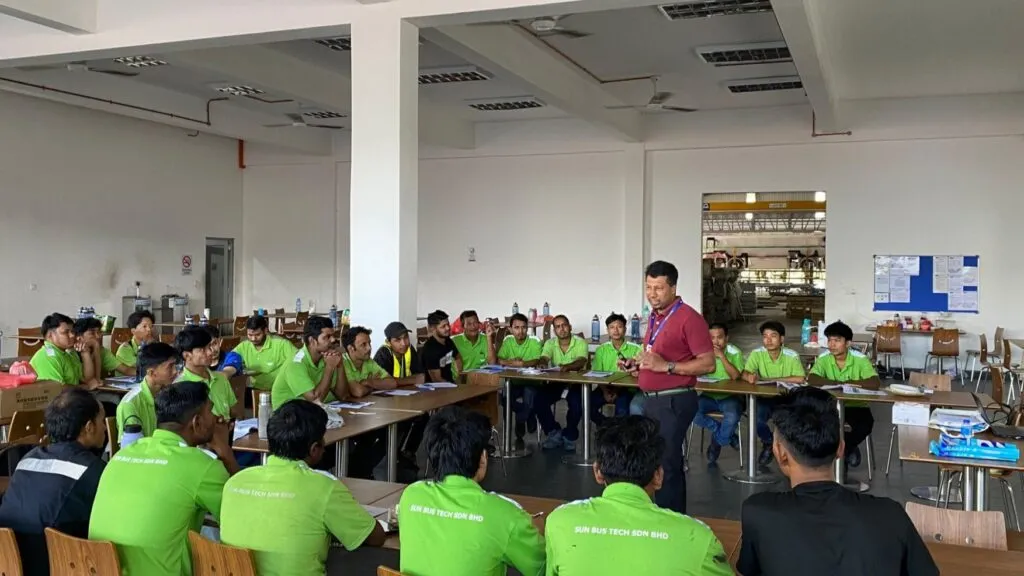
At a press conference on April 7, three industry associations — the Bumiputera Bus Operators Association (PPPBM), the Pertubuhan Gemilang Agensi Pelancongan dan Pengusaha Bas Persiaran Malaysia (GAPP), and the Malaysian Tour Van Association (PVPM) — presented a stark picture of an industry under serious pressure.
Operating costs across the sector have risen by between 25 and 40 per cent since the conflict began. GAPP president Datuk Abdul Aziz Ismail Gani noted that the price of a single bus has risen from around RM460,000 in 2019 to at least RM760,000 today, with monthly loan instalments running between RM10,000 and RM16,000 per vehicle.
On top of that, many operators are still servicing debt taken on under the Business Financing Guarantee Scheme during the pandemic. PPPBM chairman Mahazir Mat Din said fewer than 50 per cent of bus and tourism companies that were affected by COVID-19 are still operating. If conditions do not improve, he warned, that figure could fall to 30 per cent. Without government intervention, the associations said, many operators may have no more than two months before they are forced to shut down.
Currently, according to PPPBM, 5,649 tour buses and vans are registered in Peninsular Malaysia, supported by approximately 9,948 licensed tour drivers. The associations warned that continued deterioration would not only cost livelihoods but could also undermine the government’s Visit Malaysia Year 2026 campaign, which depends on a functioning and affordable ground transport network.
The Malaysian Tourism Federation (MTF) has added a further dimension to the picture. Travel agencies, it noted, sell packages months in advance under fixed contracts, leaving them unable to reprice when costs rise mid-cycle. Many are absorbing losses they cannot recover.
What Operators Are Asking For
The industry’s request is specific. The associations are calling for a diesel subsidy quota of between 4,000 and 6,000 litres per month, comparable to what express bus operators already receive, at a subsidised rate of RM2.15 per litre.

Survey data from the Malaysian Association of Tour and Travel Agents (MATTA) adds more weight to the request. The association found that 54.8 per cent of tour bus operators consume more than 3,500 litres of diesel per bus per month, while 68.5 per cent of tour van operators use more than 1,500 litres per vehicle per month. MATTA has proposed targeted subsidies of up to 3,500 litres per vehicle per month, alongside a temporary fuel surcharge mechanism modelled on the approach used in the aviation sector.
Meanwhile, MTF president Dr Sri Ganesh Michiel called for immediate relief measures and stronger coordination across ministries to ensure timely implementation.
The Government’s Dilemma
While all complaints from operators are justifiable, the Malaysian government is facing another kind of challenge. Prime Minister Anwar Ibrahim has confirmed that Putrajaya is spending close to RM6 billion per month to maintain fuel subsidies for petrol, diesel, and related aid. If the conflict persists, that expenditure could reach RM60 billion over ten months, making it a serious sustainability problem since Malaysia’s fiscal deficit already stood at 3.7 per cent of its GDP in 2025.
Anwar has been candid about the outlook. Speaking in early April, he warned that if the situation does not change within one to two months, the effects of the war will be felt across the country. The government, he said, is committed to monitoring developments and taking necessary steps to keep fuel supplies stable and prices controlled for as long as possible. Malaysia’s diplomatic standing with Iran has, for now, allowed its oil tankers to continue navigating the strait, a factor Anwar has cited as a key element of the country’s relative stability.

A Region under Strain
Malaysia’s situation, difficult as it is, remains more manageable than that of most of its neighbours. The Philippines declared a state of national energy emergency on 24 March, the first country in Southeast Asia to do so, and released an emergency fund of 20 billion pesos to secure fuel supplies. Indonesia introduced mandatory work-from-home arrangements for public sector employees and daily fuel purchase caps from 1 April, with austerity measures designed to save up to 243.4 trillion rupiah in state expenditure. Vietnam has seen diesel prices more than double since the conflict began, prompting Vietnam Airlines to suspend nearly two dozen domestic flights. In Thailand, the state fuel fund is running at a deficit of nearly 50 billion baht, with officials warning that resources will last only another two months at the current rate of depletion.
Compared to these scenarios, Malaysia’s position looks relatively stable. But stability is not the same as sustainability, and the gap between the two is narrowing, which is why, starting April 15, Malaysia will implement a Work From Home (WFH) policy for public sector employees. The aim is none other than reducing fuel consumption due to global energy price spikes.
A Glimmer of Hope
On April 9, a glimmer of hope appeared from the Middle East. It was reported that Iran and the United States have agreed to a conditional two-week ceasefire, brokered in part by Pakistani Prime Minister Shehbaz Sharif. During the ceasefire, shipping traffic will be permitted to pass through the Strait of Hormuz. The agreement came more than a month after the initial strikes, and hours after US President Donald Trump issued stark warnings about the consequences of continued closure.
Whether the ceasefire holds or whether it leads to a more durable resolution that brings oil prices back to the pre-war levels remains to be seen. Two weeks is a short window, and the underlying tensions that caused the conflict have not been resolved. For Malaysia’s truck and bus operators, this ceasefire will probably not provide everything they need.
However, what the ceasefire offers, for the moment, is a room to breathe for governments and industries. Whether that moment is long enough to matter is the question that Malaysia’s commercial transport sector and the government will be watching very closely.