Malaysia is set to raise its biodiesel blend mandate from B10 to B15, beginning with an interim rollout at B12, as part of the government’s broader response to the global energy crisis in 2026.
Malaysia Targets B15 Biodiesel to Reduce Fossil Fuel Reliance
The policy was announced under the Taklimat YB Menteri Ekonomi on April 14, 2026, with the Ministry of Economy outlining a series of medium- and long-term measures to strengthen the nation’s energy resilience amid fuel price shocks and geopolitical instability.
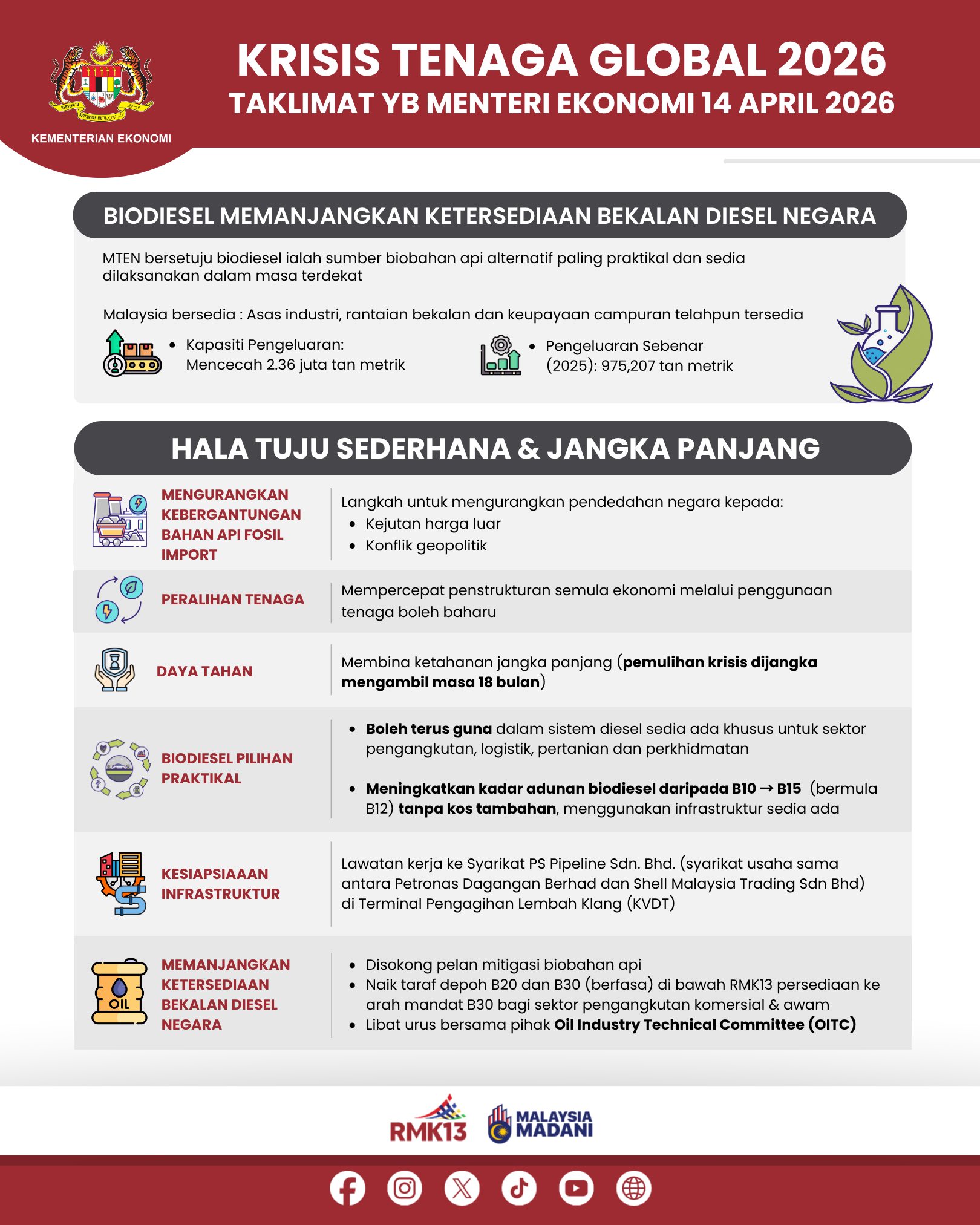
Economy Minister Akmal Nasrullah Mohd Nasir confirmed that the blend rate increase will not require additional costs, as it will leverage Malaysia’s existing biodiesel blending infrastructure, the same foundation built under the current B10 programme.
“The ongoing B10 implementation proves that the foundation for this already exists. Therefore, the government has agreed to increase the biodiesel blend rate to B15, beginning with B12,” Akmal said following a National Economic Action Council meeting.
The move is part of a wider strategy to reduce the country’s dependence on imported fossil fuels. According to an infographic shared by the ministry, Malaysia’s biodiesel production capacity has reached 2.36 million metric tonnes, though actual output in 2025 stood at 975,207 metric tonnes, indicating significant room for scale-up to meet the new mandate requirements.
Biodiesel, derived primarily from palm oil-based methyl ester, has been identified by the government as the most practical and immediately deployable alternative biofuel source. Officials noted that Malaysia’s industrial base, supply chains, and blending capabilities are already in place, making a swift transition feasible.
Beyond the immediate blend upgrade, the government has laid out longer-term plans under the 13th Malaysia Plan (RMK13), which includes phased upgrades of fuel depots to support higher blend ratios of B20 and B30. A B30 mandate is also being prepared specifically for the commercial and public transport sectors.
Since Iran’s closure of the Strait of Hormuz in late February, unsubsidised diesel prices in Peninsular Malaysia have climbed to RM6.72 per litre, and bus and tour van operators, many of whom fall outside existing subsidy quota allocations, have seen operating costs rise by between 25 and 40 per cent. Industry associations have warned that without relief, a significant number of operators could be forced to shut down within weeks, dealing a further blow to the country’s Visit Malaysia Year 2026 campaign.
For these operators, a higher biodiesel blend mandate offers a structural, longer-term answer to a problem that subsidies alone cannot sustainably solve. By increasing the domestic biofuel component in diesel, the government aims to stretch national diesel supply further and reduce the volume of imported fossil diesel that commercial fleets consume, thereby insulating the sector, at least partially, from the kind of global price volatility that has repeatedly exposed the vulnerability of Malaysia’s fuel supply chain.
To facilitate a smooth rollout, the government will conduct engagement sessions with the Oil Industry Technical Committee (OITC), ensuring that industry stakeholders are aligned with the transition timeline and technical requirements.
The government has framed the biodiesel push as a key pillar of Malaysia’s energy transition agenda, accelerating the restructuring of the economy towards renewable energy sources while building long-term resilience. Authorities have cautioned that recovery from the current global energy crisis is expected to take approximately 18 months.
“The government will continue to monitor global developments, ensure our energy supply remains sufficient, and accelerate reforms towards a more resilient energy system as a national strategic necessity,” Akmal said.