Indonesian logistics tech firm, Kargo Technologies, launches a regional EV strategy, partnering with OEMs and financiers to drive large-scale commercial fleet electrification.
40,000 Electric Commercial Vehicles to Form the “Electrified Silk Road” by 2035
Kargo Technologies, a Southeast Asian logistics technology company, has announced a major regional push toward electric commercial vehicles, outlining plans to transition up to 40,000 logistics trucks to electric power by 2035.
The electrification strategy laid out by the Indonesian-based company begins with more than 500 electric vehicles deployed in 2025, followed by 2,500 in 2026. According to Kargo Technologies‘ official statement, this will form the backbone of a future AI-driven “Electrified Silk Road”, a connected logistics network running from Southeast Asia to China and the Gulf.
Kargo‘s CEO, Tiger Fang, said the shift to electric trucks transforms logistics into a measurable, fully optimised system. “Electric vehicles allow us to see logistics not merely as transportation, but as an integrated system that can be analysed, measured, and continuously improved,” he said. For regional operators increasingly required to meet ESG standards and cost-efficiency pressures, electrification paired with digital visibility is becoming a competitive differentiator.
To support the scale of its EV transition, Kargo has secured supply partnerships with major commercial vehicle manufacturers, such as Foton, JAC, Wuling, and VKTR, all of which have EV truck manufacturing footprints in Indonesia. Their presence positions the region as an emerging production base for EV commercial vehicles.
Meanwhile, to finance the EV truck adoption, Kargo is collaborating with global financial institutions like HSBC and regional financing partners. Through these collaborations, fleet owners on the Kargo platform can access structured financing tailored for electric trucks.
Kargo is also working with large shippers, namely SPX, Astro, Teleport, and Modena, to integrate EV trucks into high-volume logistics routes. This early adoption phase focuses on quantifying energy efficiency, operating-cost benefits, infrastructure readiness, and real-world performance of electric trucks.
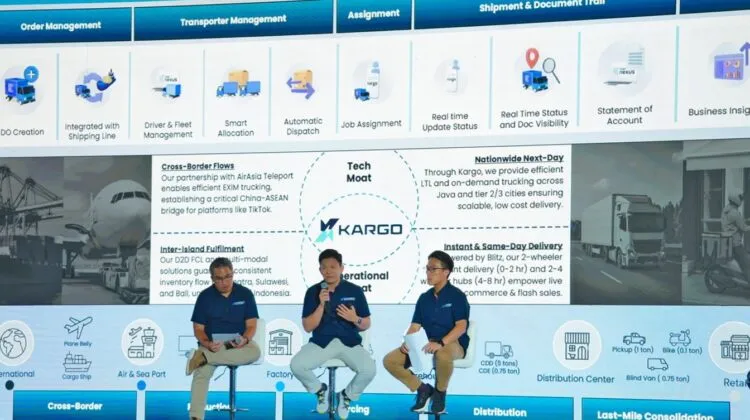
At the technology layer, the company’s Transport Management System, Kargo Nexus, connects with EV T-Box telemetry to provide real-time monitoring of fleet performance. This level of visibility, from loading to last-mile delivery, aligns with a broader regional trend toward telematics-driven fleet optimisation, increasingly demanded by shippers in Malaysia and Singapore.
While Kargo Technologies‘ operational rollout begins in Indonesia, the long-term objective is a connected commercial EV network spanning major ASEAN trade routes. A development like Kargo‘s electrification programme signals how quickly the region is moving toward cleaner, digitally integrated freight transport solutions.