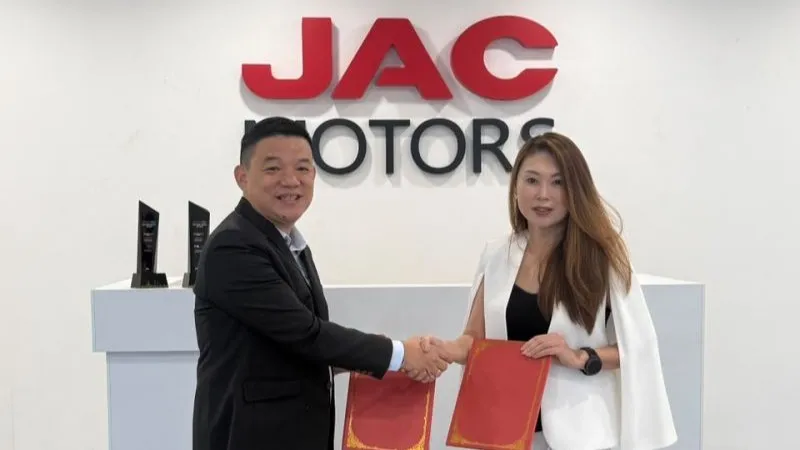
Johor-based Liep Hong Trading & Transport Sdn Bhd takes a hands-on approach to the business, with its owners remaining closely involved in day-to-day operations.
New Generation Looks to the Future
“My dad started the business in 1997, and my brothers and I took over in 2012,” explained Managing Director Johnson Tan.” Our way of thinking is different from our dad’s, so we have spent a lot of time communicating and adjusting to each other. For example, my dad believes we should continue using our old trucks until they can no longer operate. We, however, prefer to replace trucks after 10 years of service as maintenance costs become higher.”
Tan said the differences in their thinking required time for the two generations to adjust. He and his brothers eventually persuaded their father to try a new truck, pointing out that other logistics companies had grown rapidly over five years, yet the company’s fleet and operations had remained largely unchanged.
After their father’s passing, the brothers had greater freedom to put their own ideas into practice. They subsequently found that reconditioned trucks offered better value for their business.
“The new truck depreciates significantly after five years, and its resale value is not very good. It may also become more difficult to source spare parts as the truck gets older. Therefore, our fleet now consists entirely of reconditioned trucks. We only use two brands, Volvo and Hino.” he said.
Safety, reliability and spare parts availability are the three key criteria when procuring trucks. Tan said the company typically starts with two trucks for a trial before investing in more units, allowing it to assess their performance and profitability.
The company currently operates 40 trucks and specialises in construction-material transportation. “20 trucks operate between Malaysia and Singapore, while the other 20 serve customers within Malaysia. The fleet can also be reallocated to Singapore when demand increases,” Tan said.
Safety Comes First
With Singapore enforcing strict regulations on smoke opacity and pollutant emissions, Tan said the company has always avoided overloading.
“Apart from complying with the regulations, safety is also important to us. Construction materials can pose safety risks, and overloading or allowing materials to overflow could lead to accidents and even fatalities. In fact, not overloading the trucks can also help to extend their lifespan and reduce wear and tear,” he added.
The company also never skips scheduled maintenance, and all its trucks are equipped with GPS tracking and dash cams.
“Unlike last-mile delivery services, our customers seldom require real-time tracking of their construction materials. They know that their goods are in good hands and that we will deliver them safely,” he said.
What sets the company apart from its competitors, Tan said, is the hands-on involvement of its second-generation owners. He and his two brothers remain closely involved in its daily operations and understand the challenges on the ground. Another advantage is its young team, which brings a more dynamic and efficient way of working, enabling the company to respond quickly to operational needs.
Driver shortages remain a challenge for many logistics companies, especially in Johor, but Liep Hong Transport has managed to retain its drivers, many of whom have been with the company for years.
“All of our drivers stay and grow with the company, and some have been with us since my dad’s time. We offer slightly higher salaries than the market rate, along with good fringe benefits. Overtime pay and accommodation allowances are also provided,” he said.
The company is also selective when recruiting drivers. “We conduct background checks on prospective drivers to find out if they have any previous offences or issues involving drugs or alcohol,” Tan highlighted.
Regulation Remains a Challenge
Government regulations are among the company’s main challenges. Tan acknowledged that measures such as stricter overloading enforcement and speed-limiter requirements are positive for road safety, but said the implementation timeline can be challenging, particularly for smaller operators and companies with older fleets.
He also noted that there is no direct cash subsidy for purchasing and installing Speed Limitation Devices (SLDs), with financial relief instead provided through tax incentives. The diesel subsidy under the SKDS framework is administered through the MySubsidi Diesel Portal, adding to the administrative requirements.
“These measures are good, but the time given to implement them is too short. For older-generation fleet operators, many of them may not know how to apply for the incentives or complete the necessary processes. As a result, some have decided to wind up their businesses,” he said.
Tan does not expect electric trucks to gain widespread adoption in the near future without adequate charging infrastructure and greater government support. The high cost of electric trucks, together with charging requirements and downtime, remains a concern, particularly for long-haul operators.
Looking ahead, Liep Hong Trading & Transport plans to diversify beyond its core construction-material business. “Around 90 per cent of our business is transporting construction materials, with the remaining 10 per cent comprising general cargo, processed products and food transportation,” explained Tan. “We would like to expand into other services, such as bonded warehousing. We are also looking to add 10 to 20 trucks over the next two years, including curtain-sided trucks, loader trucks and bonded trucks, to cater to different market demands,” he concluded.
Image: Liep Hong